




![]() Voices of Afghanistan Featuring The Voice of Kabul & Rubāb virtuoso Ustad Farida Mahwash Homayoun Sakhi & The Sakhi Ensemble Sat, June 2, 7 pm Craneway Pavilion, Richmond, CA click for ticket info Petey Memorial
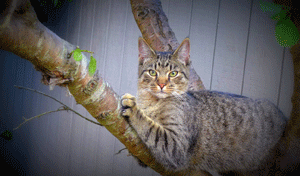
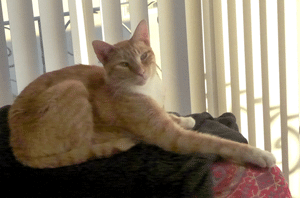
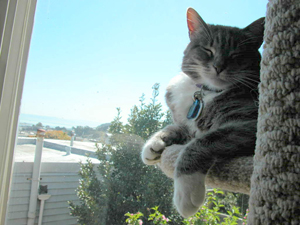
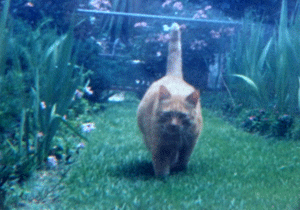
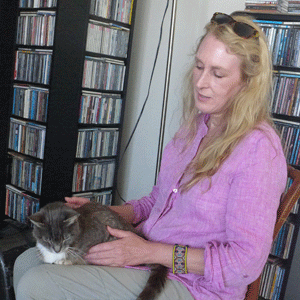
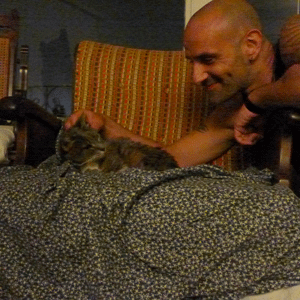
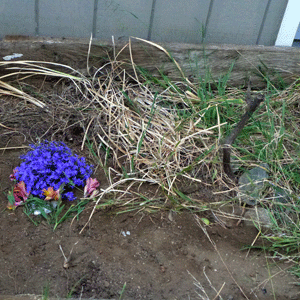
![]() HE NEVER MADE IT TO THE IGLOO April 12,2012 Rescued from a kill shelter in Manteca, Petey Pumpkinhead III entered our lives 7 years ago. Abused by a previous owner he was skittish and nippish. That changed with love, affection and attention. He was a majestic furry orange tabby. His coat emitted a perpetually lovely fragrance. He had the sexiest strut with an ever present erect tail and endearing behind. Petey had simple needs. Belly rubs topped the list. He loved resting in his backyard igloo. He would prance out when I entered the yard and open wide for belly rubs and rolly polly. He bonded with Klimey who also was rescued from a shelter. Klimey loved licking Petey and taught Petey how to love back. They were inseparable. Petey-Weedy (as we called him) evolved into the sweetest and most gentle of companions. When hungry, he would jump into bed and delicately place his paw on my face. No histrionics, just a love tap and breakfast was on. He loved sleeping inside the space between my legs or alongside the curve of Clara's thigh. His body language suggested the most delicious of dreams. He also had the squeakiest yawn when awakened. Petey had a ravenous appetite and wore his weight well. That changed last October when he dropped 2 pounds in short order and was diagnosed with congestive heart failure. He continued to lose weight but his sweet demeanor never changed. Although not a lap cat during his youth, lately I would place him in my lap in the back yard and we would stay together for long periods. These were cherished moments. Klimey would join us and stay by Petey's side. Strong medication was required every 8 hours to dissipate the fluid in his lungs. No matter how much lasix was dosed, it could not stay on top of the progression of his heart disease. Last week Petey hit a low point and could hardly breath. He hadn't eaten for 2+ days. We upped the lasix and he recovered miraculously. His breathing appeared normal and he started eating - but only food fresh out of the can. He ate more than he had in months. He had playful sparring sessions with Klimey, tons of rolly polly and belly rubs, his tail was erect and he slept next to my face the other day. Today he had a good appetite in the early afternoon. I didn't see him the rest of the day. When the thunder rumbled and the rain came pouring down I went outside. He was in the igloo. I tipped it and he ran inside. But something was wrong. His breathing was labored. Petey could not catch his breath. He had breathing attacks before and I had feared the worst, yet Petey always persevered. An hour or so later when Clara came home, Petey's condition had worsened. When he walked from under a table to lie down in the litter box that was an alarming signal. I picked him up and he let out a cry. Petey went under the bed where Klimey was and continued to make anguished yelps. We left him alone. Petey soon emerged and we put him in a blanket by the heater. He wanted to be left alone. Petey-Weedy barely could walk and stumbled out the bedroom and down a few steps to the cat door. Somehow he pushed himself through. The igloo was two feet from the door. We let him be. An hour later Clara checked on Petey. His fur was gorgeous. His body still warm. But Petey had passed. He never made it to the igloo. |
![]() Listen to Tangents The most recent Tangents show ![]() Tinariwen on Tuareg Quest for Independence (interview posted by Tom Devriendt, Africa is a Country 4/2/12)
Musical Reflections on Events in Northern Mali Our recent post about Khaira Arby, Vieux Farka Toure and Bassekou Kouyate creating a song pleading for peace in their native Mali made me reflect. They are all extraordinary, internationally celebrated artists from different backgrounds. Khaira's heritage is Berber and Songhai. Vieux's is Sonrai. Bassekou's is Bambara and Mande. In my many interviews with the late Ali Farka Toure, he always delighted in the multi-ethnic heritage of his beloved north and pointed out that he drew from different languages, folklore and music styles for his art. When I met Khaira in Timbuktu in 2000, she likewise talked about Timbuktu as an exciting and rich crossroads of different ethnic groups that inspired her. Songhai, Tuareg, and Sonrai artists all perform takamba, a style marked by slow, graceful arm and hand movements that you see in every Tinariwen performance. The origins go back to the Songhai Empire, hundreds of years ago. And the Tuareg developed their own version in the last century. One of Habib Koite's first hits was "Fatima" also in the takamba style, showing his eager embrace of all Malian culture, not just his own ethnic group. At the Festival in the Desert in Essakane in 2003, we saw Oumou Sangare, the premier Wassoulou singer from the south perform takamba and she called on stage Ali Farka who danced it brilliantly--beaming and serene. The point is that Mali is a multi-ethnic society through and through. This goes way back to the 13th century when Mali became an empire. And Mali has always prided itself as multi-ethnic. What could so easily be a source of division has been instead an admirable source of national pride. So for one ethnic group to declare that half the country is their independent homeland flies in the face of the reality of centuries of people from different ethnic backgrounds in the north of Mali--the sedentary Sonrai farmers, the nomadic Tuareg, the Fula, the Bozo fishermen, various desert tribes--living in relative symbiosis. And it's pretty clear that the 100,000 to 200,000 or more Malians who have fled their homes in the north don't feel particularly liberated. I'm not trying to take any sides in this complicated situation and I don't pretend to fully understand it. Of course the Tuareg have been on and off fighting for their rights/independence since colonial times. And they have sometimes been treated brutally and certainly have legitimate grievances. Furthermore, they have suffered massive droughts that have killed off flocks and existentially compromised the very possibility of their nomadic lifestyle. But we in the West need to be careful about regurgitating press releases and simplistic marketing campaigns. If the way to redress the unfairness of colonial borders and policies of neglect were to fight for ethnically-based homelands, the African continent would be awash in civil war, north to south. This piece in the New Yorker on-line, detailing Tinariwen's lyrics and the story of the Tuareg is the best I've seen on the subject from the Tuareg point of view. Note that the father of Ibrahim Ag Alhabib, the Tinariwen guitarist/singer with the big shock of black hair, was executed by the Malian government in 1963 for helping the rebels. He comes to his convictions through hard life experience. What has dismayed me most in the last several weeks is the scant attention paid to the plight of the 100,000 + refugees in the north who scattered to Mauritania, Algeria, Niger and within Mali. This is the deadly hot season. What is happening to these non-Tuaregs? Is there enough food and shelter and water? Is there medical care? Live Links to organizations helping refugees in northern Mali — now scattered to Mauritania, Algeria, Niger and internally in Mali. Please forward to simpatico friends and colleagues.
Songlines Music Travel Songlines upcoming 2012 trips include Lisbon, Essaouria (Morocco): Gnawa and World Music Festival, Malaysia: Rainforest Festival, Guca, Serbia: Guca Brass Band Festival, Malawi: Lake of Stars Festival, Mali, Senegal, India and more! |
This often features a Palestinian artist or music connected to Palestine in order to help focus attention on relieving the humanitarian crisis in Gaza. Gaza Corner has evolved to include music from other regions of the Middle East and North Africa as the Arab Spring unfolds. Gaza Corner began soon after Israeli commandos killed nine Turks aboard an aid flotilla bound for Gaza in 2010. ![]() Palestinians wear hoods with printed faces of Palestinian prisoners on hunger strike in Israeli jails during a support rally in Nablus, May 12, 2012. Photo by: AP Talks ongoing to end Palestinian hunger strike (AP, Haaretz 5/12/12) Talks ongoing to resolve hunger stike demands
(Ma'an News Agency, 5/12/12) Palestinian
officials says Egypt is trying to mediate between hunger strikers and
Israel; Rights groups say around 2000 Palestinian prisoners are currently on hunger strike.
combined excerpt:Israelis and Palestinians are negotiating through Egyptian mediators to end a mass Palestinian hunger strike.
Talks are trying to secure three demands; an end to administrative detention, family visits for prisoners from the Gaza Strip, and an end to the policy of solitary confinement. Rights groups say around 2,000 prisoners are on hunger strike to demand improved conditions in Israeli jails. According to prison officials 4,600 Palestinians are held by Israel. The Egyptian brokered talks mark the first time that substantive negotiations have been reported to be under way to defuse the protest since it began weeks, and in some cases months, ago. Two men, Thaer Halahleh and Bilal Diab, have been on strike for more than 70 days. Both are members of Islamic Jihad, a Palestinian militant group that has killed hundreds in suicide bombings, shootings and other attacks. It is not clear whether Halhaleh and Diab were involved in any militant activity because they are being held under "administrative detention," a policy that can keep some Palestinian prisoners for months - even years - without charges. Israel has defended administrative detentions as a necessary tool to stop militant activity. The fate of the hunger strikers has touched a raw nerve in the Palestinian territories with daily demonstrations in the occupied West Bank and in the Gaza Strip to support the protest. An estimated 40 percent of men in the occupied territories have been detained by Israel at some point in their lives. Tangents Turkey Music Tour |